Why Venture Studios Beat Accelerators for Early-Stage NZ Founders
Why Venture Studios Beat Accelerators for Early-Stage NZ Founders
Here's the uncomfortable truth about startup support in New Zealand: accelerators work best for founders who already have traction, but most NZ founders with just funding and vision need co-builders, not coaches.
Walk into any Auckland coworking space and you'll meet Builder Ben — just secured pre-seed funding, has a killer product vision, but sits alone staring at a whiteboard wondering how to actually build the thing. Traditional accelerators want him to have an MVP. Venture studios want to build it with him.
Startup accelerators work with existing startups, typically at an early stage, and these programs primarily focus on helping early-stage technology companies grow. But what happens when you're not quite at that "existing startup" stage yet?
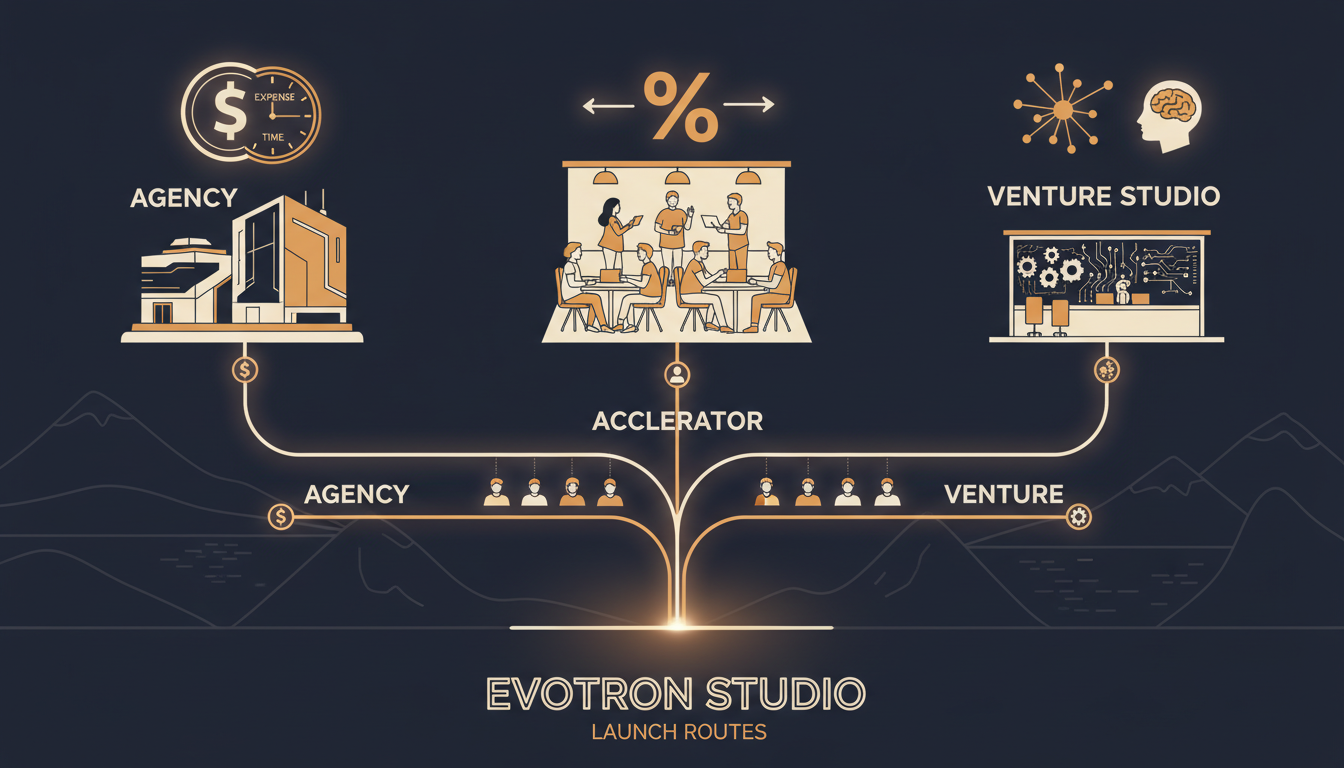
The Two Paths Forward
In the NZ startup ecosystem, you've got two main paths:
- Drive AI agents yourself — Use platforms like Evotron and Supramono to build and market your product
- Partner with an agentic venture studio — Have humans drive those agents for you while you learn
Most founders think they need option 1. Most actually need option 2.
Why Accelerators Miss the Mark for Pre-MVP Founders
Startup accelerators are often 3 months in length with a primary focus on raising additional capital, operating cohort-based programs focused on education and content. Of the 200+ applications each year to programs like Startmate, only 8 to 10 get selected, with successful applicants receiving $75k funding in return for 7.5% equity.
The problem? You're competing with 190+ other founders for a spot in a program designed for startups that already have product-market signals. These programs typically culminate in a Demo Day event where startups pitch to a group of investors — but what are you demoing if you haven't built anything yet?
The Cohort Problem
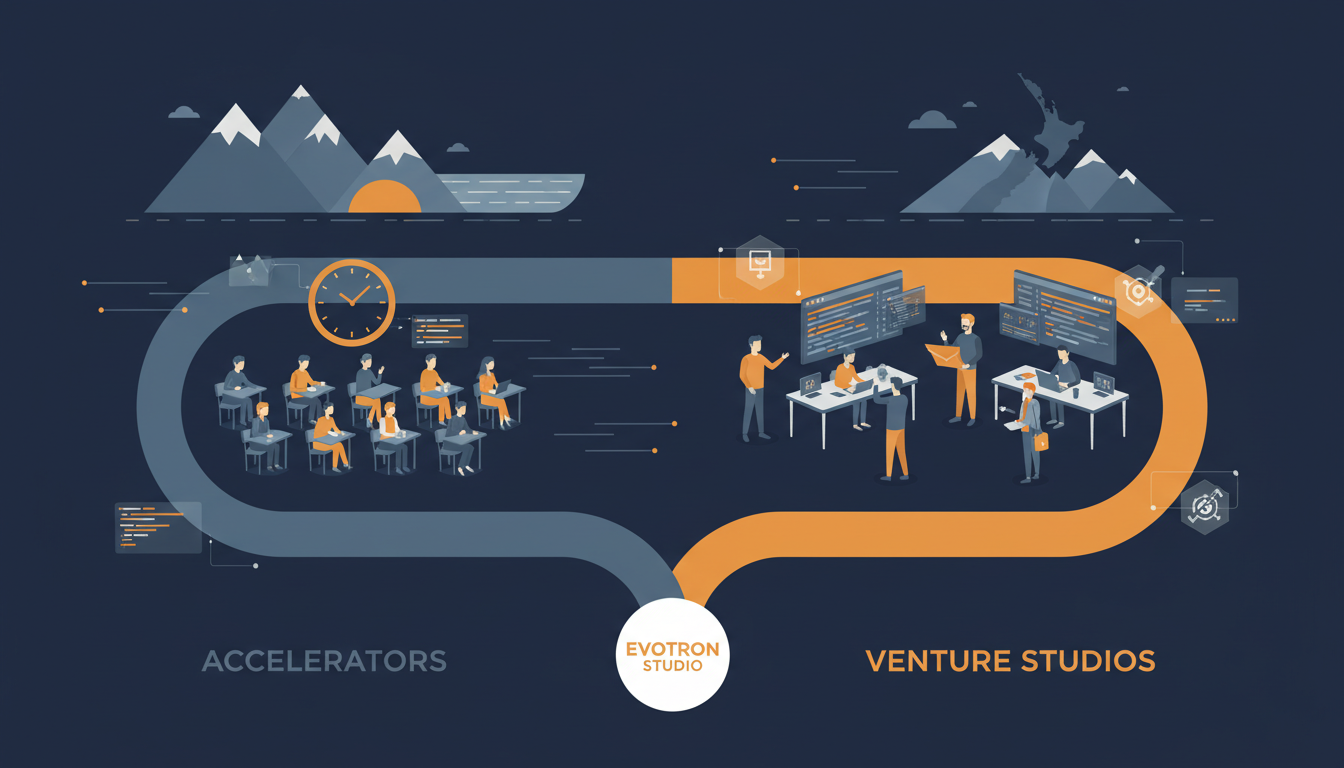
Accelerators run for a set period, typically three to six months, during which startups receive intensive support to accelerate their growth. Everyone moves at the same pace. Everyone graduates at the same time. Everyone's forced into the same funding timeline.
But Builder Ben's SaaS idea might need 4 months to validate, while Sarah's hardware concept needs 8. The cohort model doesn't bend.
How Venture Studios Actually Work
Venture studios create startups from scratch, generating ideas internally and providing capital, talent, and operational support in exchange for significant equity stakes (typically 30-80%). Unlike accelerators that coach from the sidelines, studios get in the game.
The Co-Builder Approach
Venture studios are deeply involved in the daily operations, often acting as a co-founder, while startup accelerators provide mentorship and resources but do not involve themselves in daily operations.
Imagine having access to senior developers, designers, and marketers from day one. Venture studios help validate the idea, build the MVP, craft the go-to-market strategy, and launch with a full stack team in place — meaning from day one, you're working alongside operators, designers, engineers, and growth leaders.
The Time Factor
Studio-backed startups reach seed funding in 10.7 months versus 36 months for traditional startups, and Series A in 25.2 months versus 56 months. When your runway is finite, those 25+ months matter.
The most significant competitive advantage for venture studios is time compression, with studio startups reaching seed funding in 10.7 months compared to approximately 36 months for traditional ventures.
The NZ Context: Why This Matters More Here
The hard truth is this: venture-style blitzscaling doesn't fit the New Zealand context. Instead, what truly works here is a Bootstrap First, Raise Money Later approach. Because of geography, every successful New Zealand founder understands that their first market is rarely domestic — from Xero in accounting SaaS to Rocket Lab in aerospace, global ambition is non-negotiable.
NZ founders face unique challenges:
- Small domestic market means thinking global from day one
- Limited local investor pool
- Geographic isolation from major tech hubs
- Need to prove international viability early
New Zealand's startup ecosystem is supported by a core group of accelerators and venture capital firms primarily focused on helping early-stage technology companies grow. But "early-stage" often means "already building" — not "have an idea and funding but need execution."
When Accelerators Actually Work
Accelerators are great if you have a product, early customer interest and/or validation, and a big vision, but need guidance, traction, and intros to investors and customers to get to the next level.
The accelerator approach works well for founders who already have a solid concept and MVP but need resources, connections, and strategic guidance to scale quickly.
If you're Scale-Up Sarah with an MVP and early revenue, accelerators make perfect sense. If you're Builder Ben with funding but no product, you need co-builders.
The Middle Path: Agentic Venture Studios
This is where the future gets interesting. Traditional venture studios often want to own your idea and take massive equity. Venture studios typically take significant equity stakes of 30-80% because they're building from scratch.
But what if you kept your idea, your vision, and most of your equity — and just partnered with experts who know how to drive AI agents effectively?
That's the agentic venture studio model. You bring the vision and domain expertise. They bring the execution framework and AI-powered tooling. You maintain control while gaining a true co-building partner.
The Decision Framework
Choose an accelerator if:
- You have an MVP and some traction
- You need investor connections and demo day exposure
- You can commit to a fixed 3-6 month timeline
- You work well in cohort-based learning environments
Choose a venture studio if:
- You have funding and vision but need execution
- You want hands-on co-building, not just mentorship
- You prefer 1:1 partnerships over cohort programs
- You need help with the entire build-to-market journey
For most early-stage NZ founders with just funding and a validated idea, the choice is clear. You don't need coaching — you need co-building.
The question isn't whether you'll use AI agents to build your startup. The question is whether you'll learn to drive them yourself or partner with experts who already know how.
Most successful founders choose the latter. At least until they don't need to anymore.
Ready to explore the co-building approach? Learn more about how venture studios can accelerate your journey from idea to revenue at Evotron Studio.
Evotron Studio
We help founders build and sell.
We help founders build and sell.
Learn more about Evotron Studio and get started today.
Visit Evotron Studio